It’s high time we de-exoticized fiscal sponsorship.
This blog post is an accompaniment to our Messaging Toolkit and features at the end two sample explainer texts for reference, one in plain English for the lay public, and one for legal or tax audiences.
In order for the field of fiscal sponsorship to define itself and build a community of practice over the last forty years, it needed to adopt identifying terminology and ways of describing practice to distinguish this work within the broader nonprofit sector.
The act of naming something– “this is fiscal sponsorship”–is always an act of both othering and belonging. So, to define the field and grow it, we necessarily had to exoticise it. Today that exotic character has become a liability, as it provides a pretense (albeit flimsy) for suspicion, innuendo, and the outright false allegations being directed toward the field by political and social opponents to the civil society work fiscal sponsors steward.
Maybe it’s time for us to de-exoticise fiscal sponsorship, as it enters a new era of growth and strength as an essential element of US nonprofit infrastructure.
Much of the growing attack on the fiscal sponsorship field is rooted in a perception that fiscal sponsorship is some kind of legal dodge, a workaround, or otherwise exceptional case in the tax-exempt sector–one that leads to less transparency, and more nefarious activity. This couldn’t be further from the truth. Fiscal sponsors are just as legally compliant and transparent as any other 501(c)(3) public charity.
These false perceptions are, in part, enabled by the language our field has adopted. This lingo–i.e., the “models”, sponsor, sponsee, project, and the term “fiscal sponsorship” and its variants–are not legally defined. They are terms of identity and identification describing a range of charitably compliant operating approaches to managing discrete charitable initiatives under one organization. That’s it.
When Greg Colvin set out to create his taxonomy of models in the early 1990s, he was merely cataloguing long-established, compliant legal structures endemic to the nonprofit sector. He coined the term fiscal sponsorship as a general rubric for these structures. Colvin’s project was motivated at the time by both a lack of clear terminology and the use of incorrect terminology, such as “fiscal agency”, which denotes a relationship that the IRS would in fact consider non-compliant.
Fiscal sponsorship has been around since the late 1950s, and has experienced steady organic growth over the intervening decades, with precipitous growth tracked since 2000, as we learned in our 2023 Field Scan. While growth has been steady, it’s been largely organic. True intentional field building didn’t begin until the early 2010s and has not accelerated until the advent of Social Impact Commons–the only staffed field building organization–in 2020.
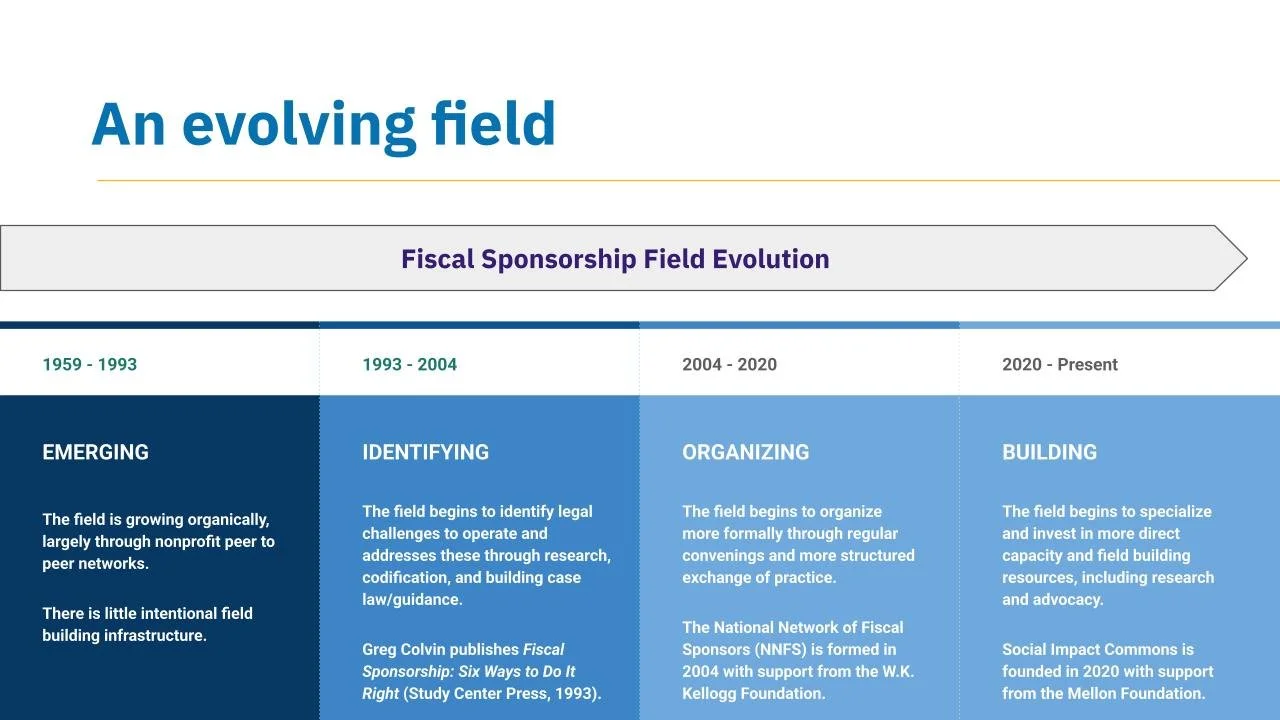
Source: Social Impact Commons
One of the reasons that the field has been able to grow for so much of its history without intentional field building, organizing, and defining terminology is owing to the fact that fiscal sponsorship is built on bedrock legal and tax concepts that have been used in the nonprofit sector for some time, with or without being identified as fiscal sponsorship.
For example, we regularly encounter organizations that do not identify as fiscal sponsors managing programs using the tools of fiscal sponsorship. A more current and high-profile example is the Trump administration’s Freedom250 project, which is a Disregarded Entity (Model L) fiscal sponsorship structure under the National Park Foundation. Neither the Foundation nor the administration considers this arrangement fiscal sponsorship. Yet, in form and operations, it is just that.
While we’ve spent many years developing and clarifying language to draw a boundary around the field so we can build it, it may be time for a bit of a pendulum swing in the opposite direction of normalizing fiscal sponsorship as just another way in which the charitable sector has always supported its impactful work.
Below are two explainers aimed at a more plain English and normalizing framework for fiscal sponsorship. These are also available in our Messaging Toolkit.
PLAIN ENGLISH EXPLAINER - What’s fiscal sponsorship?
Fiscal sponsorship is an approach to managing multiple charitable programs under one nonprofit organization.
There are about 2 million nonprofits in the US today, nearly all of which run multiple programs that fulfill their charitable missions. For example, a church may operate a soup kitchen, a youth group, and community outreach as three separate programs. A neighborhood association may manage a local park, and a street greening program under its nonprofit. In these cases, programs are typically originated and managed by staff and leadership of the nonprofit that houses them.
Fiscal sponsors are 501(c)(3) tax-exempt organizations that welcome mission-aligned programs, new or established, from individuals or groups outside the charity’s staff and leadership. These could be community leaders, field experts, civic organizers, etc. The fiscal sponsor brings the program under its management control, but allows for the program and leaders to maintain more independent public identities and relationships with the people they serve than an “in-house” program, while acknowledging their nonprofit home–for example, Hometown Youth Group, a fiscally sponsored program of Acme Community Services, Inc., a 501(c)(3) nonprofit.
Under longstanding Treasury/IRS guidance, The sponsor is fully responsible for fiscal oversight, charitable compliance, tax reporting, and overall legal and public accountability for the sponsored program, in the same manner as any 501(c)(3) nonprofit program. Fiscal sponsors are no more or less transparent and accountable than any of the 2 million nonprofits in the US today.
There are several types or “models” of fiscal sponsors with two kinds being most prevalent. The re-granting fiscal sponsor relationship allows the sponsored charitable program to raise gifts and grants through the sponsor, which are then re-granted to the individual or entity doing the charitable work. The sponsor retains full control over and compliance accountability for the re-granted funds. The comprehensive fiscal sponsor relationship brings all of the sponsored program’s operations (income, expenses, financial management, HR, compliance) under the sponsor nonprofit, offering the same back office support and oversight that any nonprofit provides its own programs.
Some charities nonprofits are only fiscal sponsors, gathering mission-aligned charitable programs from the community under one roof to ensure better efficiency, legal compliance, and public accountability. Some nonprofits support fiscally sponsored programs alongside their own in-house programs. In the end, fiscal sponsors are simply multi-program nonprofit organizations where some of the programs originate from within and are closely identified with the nonprofit, and some originate from outside the organization and maintain a bit more independence of identity and relationships with donors, funders, and the people served.
LEGAL EXPLAINER – How is fiscal sponsorship built on existing legal models?
This section was authored by Greg Colvin, July 13, 2026
In the decades before 1990, there was no generally-accepted name (and a lot of incorrect names, such as conduit, pass-through, or intermediary) for the various legitimate ways that a larger, older 501(c)(3) organization could help a smaller, newer charitable project get started with access to tax-deductible funds.
After John Edie wrote the Council on Foundations 1989 article “Fiscal Agents: A Trap for the Unwary,” a group of us assembled, drawn from local community services, arts and culture, independent film, with private and community foundations, to set things right. The term “fiscal sponsorship” was selected and our law firm was engaged to write a handbook for use across the spectrum of the best legal models approved by the IRS.
Model A, the direct or comprehensive form, long in use by universities, medical institutions, and community hubs, followed the pattern of in-house departments, clinics, centers and other programs that sought to benefit from grants and donations directed to them, subject to a range of administrative charges. Treas. Reg. 53.4945-4(a)(4)(i),(ii) and (iv).
Model B is a simple way to engage an independent contractor, such as an artist, composer, convention planner, or other professional to produce a charitable work or event, with due regard for intellectual property rights and tax rules, e.g. IRS Publication 1779 and IRS GCM 39883.
In Model C, the pre-approved grant to a project that does not have its own 501(c)(3) status, (aka re-granting), the bedrock principle is that the sponsor must maintain “discretion and control” over the grantee’s use of the grant funds by receiving and approving a grant proposal before solicitation and obtaining timely reports on the use of granted funds. This model is used widely in arts and culture, in support of new charities while waiting for IRS recognition, and in foreign grant-making. In fact, the leading authority, Rev. Rul. 66-79, emerged from IRS rulings issued to United Jewish Appeal in the early 1960s, which raised millions from US donors to build up the educational system in Israel. See also Rev. Rul.68-489.
Model D, the group exemption, is used by a wide range of 501(c)(3)central organizations that confer charitable tax status upon local units, including churches’ congregations, educational, and health organizations and other national and state bodies with numerous chapters and clubs that are subject to their supervision and control. Rev. Proc 80-27, recently modified by Rev. Proc. 2026-5.
Model L is a new form of fiscal sponsorship recognized under IRS Notice 2012-52 and IRS General Information Letter 2010-0052. It allows a 501(c)(3) organization to go beyond Model A and act as the single member of a limited liability company to hold assets or conduct an activity that shares the charitable exemption of its sole member while shielding it from liabilities. It has been used for projects as diverse as Black Rock City LLC solely owned by the 501(c)(3) Burning Man Project, and President Trump’s recent Freedom250 operating as a subsidiary of the National Park Foundation.
Lastly, Model F is simply a paid form of technical assistance management services provided by one 501(c)(3), below cost, to another recognized charity for purposes of efficiency, recognized by GCM 38447, a series of Revenue Rulings issued from 1969 to 1978, and Airlie Foundation v. IRS, 283 F. Supp. 2d (D.D.C. 2003).
Author, Fiscal Sponsorship: 6 Ways to Do It Right, Study Center Press, 1993, 2005, with Stephanie Petit, 2019